Language

Pulished on Nov. 06, 2026
A first container of kitchenware often fails in a predictable way. The buyer picks 40 SKUs, spreads them across six materials, and finds out in month three that tongs and peelers sold out while the knife blocks are still on the shelf. A 2027 range is easier to defend if each product has a job to do before it goes on the order sheet.
The market backdrop supports that approach. Industry estimates put China's 2027 small kitchenware exports at about RMB 54–55 billion. Growth is expected to ease to roughly 4.5%–6%. The years of fast, across-the-board expansion are over, and growth is now structural. Demand is moving to specific product types, price tiers and channels. A wholesaler who buys the whole catalogue evenly will therefore perform worse than one who concentrates on a few lines.
Slower growth removes the cushion that used to cover a weak buying decision. When the whole category rises, a mediocre SKU still sells eventually. At 4.5%–6%, a slow SKU ties up shelf space and cash.
Market mix matters too. Europe and South America together account for roughly 30% of Garbo's kitchenware business. They shape buying in different ways. European buyers tend to ask more about material declarations, packaging and labeling. South American distributors often work with mixed containers and tighter price ladders. Check the compliance and packaging rules of your own destination market before you treat either description as your own.
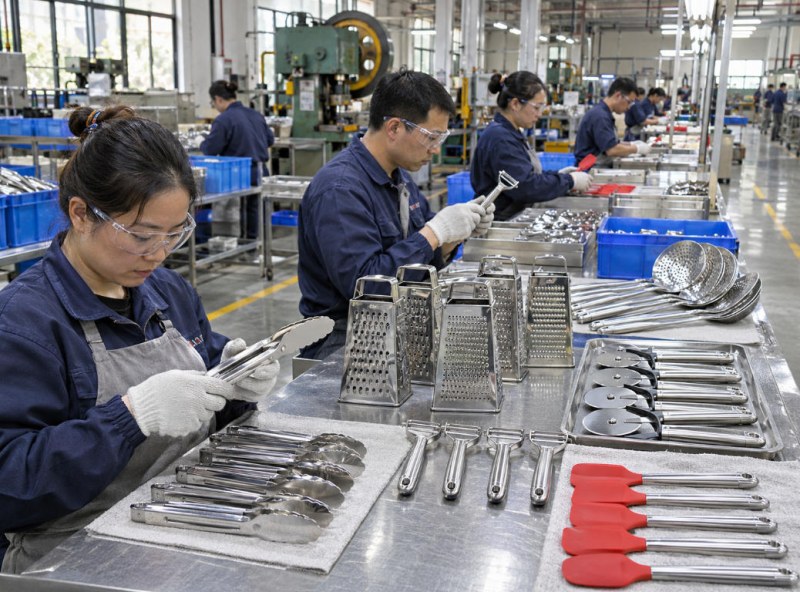
Wholesale cooking utensils such as tongs, peelers, graters, skimmers and spatulas form the core replenishment layer.They are also easy to mix into one container. If these run out, you los e regular customers, so they should get the largest share of your first order.
Knife sets, utensil sets and baking tool sets carry a higher ticket and a better margin. They also depend on set composition, packaging and finish, which makes them harder to compare between suppliers. Buy fewer of them, and make sure each one has a clear price position.When comparing a kitchen knife set supplier, check the set composition, blade material, handle construction, packaging and intended price position.

BBQ tools and wine accessories belong here. Volume swings with the season and with promotions, so order the smallest lots your supplier allows and test them. Missing a season costs you less than overstocking one.
Many buyers put too much of the budget into this third layer because it looks the most attractive. The first layer is where repeat revenue comes from.
The table below sets the main kitchenware groups side by side. It covers each group's role, where it sells, what to confirm, what drives cost and what to watch. The MOQ column shows indicative starting quantities per SKU, per design or color, so you can size a first order. Final MOQ depends on the material, finish, packaging and customization, so confirm it in the quotation for each item.
| Product group | Role in the range | Indicative starting MOQ (per SKU) | Best-fit channel | Specs to confirm per SKU | What drives MOQ and unit cost | Main risk |
|---|---|---|---|---|---|---|
| Cooking utensils (silicone, stainless steel, wood handle) | Core replenishment | 3,000–5,000 pcs | Supermarkets, online distributors, general retail | Material and grade, temperature limit, handle construction, dishwasher guidance | Material, handle type, color, logo and packaging | Assuming one heat limit applies to the whole line |
| Small kitchen tools (tongs, peelers, graters, skimmers, pizza cutters, bottle o peners) | Core replenishment | 3,000–6,000 pcs | Supermarkets, hardware and homeware retail, hotel supply | Steel or material grade, edge quality, spring or joint strength, size | Variety of designs, finish, hang-card or blister packing | Too many near-identical variants splitting sales |
| Kitchen knife sets | Set and gift item | 2,000–3,000 sets | Retail and private label, gift programs | Blade steel, edge finish, handle material, block or sheath, target-market compliance | Set composition, handle and block choice, packaging | A lower quote reflecting a different steel or lighter handle |
| Stainless steel containers and lunch boxes | Steady mid-ticket item | 2,000–5,000 pcs | Retail, online, reusable-product programs | Steel grade, lid and seal design, dishwasher guidance, capacity | Size range, lid parts, finish, custom packaging | Lid and seal complaints, which photos will not reveal |
| Baking molds and baking tools | Set item for home baking | 3,000–5,000 pcs | Specialty retail, online distributors | Material, temperature range, release and cleaning behavior, dimensions | Number of shapes and sizes, color, packaging | Small variants multiplying quickly |
| Cutting boards | Container filler | 2,000–3,000 pcs | Supermarkets, homeware retail | Material, thickness, size, finish, edge treatment | Material, size count, logo or engraving | Bulk and freight cost eroding margin |
| BBQ tools | Seasonal | 2,000–3,000 sets | Seasonal retail, promotions, outdoor programs | Metal finish, handle material, set composition, retail packing | Set size, finish, display packaging | Unsold stock after the season |
| Wine acces sories | Seasonal and cross-sell | 3,000–5,000 pcs | Gift programs, bar and hotel supply | Finish, mechanism durability, set composition, gift packing | Set composition, finish, packaging | Gift packaging cost outweighing product value |
For reusable lunch boxes and storage products, compare each stainless steel container supplier by steel grade, lid structure, seal design, capacity and packing method rather than price alone.
Three judgements follow from the table. First, the groups with the lowest unit price are not automatically the cheapest to stock, because variant count and freight can change the economics. Second, knife sets and stainless containers are where a cheaper quote most often hides a specification difference, so compare the written specification before you compare the price. Third, with starting quantities at this level, every extra variant adds thousands of units of inventory. Cutting the SKU count matters more than negotiating the quantity per SKU.
Supermarkets and retail chains. Simple retail packaging, a clear price ladder and a short list of fast movers. Weight the range toward core tools and one or two set options.
Hotel and restaurant suppliers. Durability and repeat supply matter more than novelty. Prefer stainless steel tools and containers, and keep the SKU list stable from year to year.
Online distributors. Packaging has to survive parcel shipping, and listing photos have to match the product. Smaller sets and single tools with clean packaging tend to work better than bulky items.
Private-label programs. Narrow the range to a few items and invest in packaging and finish. Custom options can include shape, color, logo, surface treatment and set composition, with terms confirmed per project.
Start with a narrow first range and a defined reorder point for each SKU. A workable first range for a mid-sized wholesaler has four parts:
A cor e of utensils and small tools.
One or two knife-set options at different price points.
A small stainless container line.
A trial lot of seasonal items.
Use the first quarter's sell-through to decide what to expand. Limit each category to two or three materials, because quality control, complaint handling and reorders all get easier. Kitchenware also ships well alongside other categories. If you buy flatware or opal glass as well, the products page shows how one supplier can cover several categories, and the flatware category is a natural companion for a mixed container.
"Food grade" on a quote is not enough. Ask for these per SKU:
Material and grade
Food-contact suitability for your destination market
Temperature limits
Handle construction
Edge and sharpness requirements, for knives
Coating and dishwasher guidance
Dimensions, carton packing and labeling
For custom work, add shape, color, logo, surface treatment and set composition. MOQ, tooling, sample timing and production lead time should be confirmed in writing for the specific item. They are not category constants. For more sourcing guides, see the tableware articles section.


 Previous:
None

Garbo at 139th Canton Fair: 30+ Years of Glass Heritage + In-House Cutlery Factory

Garbo 139th Canton Fair : Full range of Glassware and kitchenware products, one-stop customizat...

Brilliant Tableware Illuminates Life: Garbo International Shines at the 2026 Shanghai Inter...

Garbo+ Stainless Steel Cutlery and Tableware Impress at the 138th Canton Fair

Garbo International boss leads sales team for global business trip